When I was two, a cop found me and my friend Timmy asleep in a storm drain in the woods behind our house. Connecticut state police searched for hours and were preparing to drag a nearby river when one of them located us curled up together. “Oblivious,” my mother called our napping through the shouting and excitement by the river. Apparently, we’d followed a steep trail my grandfather used to trout fish and got sidetracked. I vaguely recalled an echoey chamber but nothing else until I was forty.
No one asked why Timmy and I were left unattended. My mother hated perusing family photos and shared so few stories of our childhoods and fewer still of her own, my sister and I felt forgotten. When referring to her plucky toddlers, my mother always skipped to how, before I could walk, twice she’d had to climb through a small basement window to get into my room. I’d rocked my crib in front of the door, wedged the doorknob between its bars and made it impossible to open. “We tied the crib to the opposite wall,” she tittered, covering her mouth before my father could afford to have her teeth replaced. “And we staked you in the yard,” my father proudly added, admiring the well-composed snapshots he took of me in a harness.
Born poor and Canadian, my mother prized grit above all else including parenting. I inherited her sinew, susceptibility to molestation and bad teeth which my father also paid for, after I’d moved back in with them at age forty. In exchange for a place to sleep, I rarely brought up my childhood and did my best to hide my bitten nails, nervous legs and finger tapping knowing it drove them nuts.
They had no idea their forty-year-old son had been upstairs rocking back and forth on his hands and knees in an imaginary crib performing an exercise suggested by his acting teacher to put him in touch with his inner child. When I blew by them afterward saying, “Off to class,” heading out to find the cement pipe, they hoped I might be Broadway bound.
It was a grey, windless July afternoon. Tree branches hung ready to crack from the weight of summer leaves as I drove in the grip of a manic high seeking kismet rather than professional help.
Lying on her shag carpet amid a roomful of other thespians, my teacher tried to make me face my inner child. While others inner children sat in highchairs or played with toys, expressing their deepest desires, mine lay alone saying nothing. I thought it was dead at first until rocking back and forth, it occurred to me, I might’ve intentionally locked my mother out twice.
The echo of the storm drain drew me to the neighborhood I’d not seen in nearly forty years. The house was tiny – a first-home kind of place sitting nowhere among similar ones bulldozed into a rocky hill. Kids stopped playing and posed photogenically on Dogwood, Birch and Laurel lanes ready to run as my cat shit-colored Chevy Citation crawled by.
The house I parked in front of was for sale. “I might’ve predicted this,” I thought, able to poke around it while looking less suspicious.
When I wasn’t desperately depressed, I’d been winning scratch off lotteries. My eyes widened for unseen reasons during acting class, and I was known to freeze for no reason and jolt like a nervous cat at sudden movements which annoyed fellow students.
I’d begun taking Paxil a few days before which hadn’t kicked in yet, “or had it?” I wondered, thumping my nubby fingers on the steering wheel with the gauzy window, cement pipe, dying rat my sister told me I’d been bitten by and a mystery rash my father happened to mention swirling in my head.
I emerged from my Chevy in running shorts and a tank top like a prospective buyer concerned whatever drew me there might get me arrested. Imagining prison sex offenders while making my way to a rhododendron which had seen better days, a ground level window caught my eye.
The fragile branches I leaned into to get a better look snapped loudly beneath me as I wondered how on earth my mother could fit through a such a small opening. Picturing her tiny Canuck feet dangling toward the floor, I heard her swear, “God Damnit,” blocking the light as an aluminum frame that small wouldn’t possibly allow her through.
Imagining mind-bending boredom and my crib being thrust back across the room twice, suddenly filled me with unexpected gratitude. “Was this the Paxil,” I wondered backing out of the sick bush?
My mother never consoled me once in my entire life, I thought, heading around the house, yet I was grateful to have inherited her intrepid spirit which I believed led me there, when seeing no back yard I realized I was at the wrong house.
The house next door had a trampoline and a small above ground pool out back. Noticing its basement windows were large enough for an adult to crawl through, I saw Timmy Gavin and I descending into the woods holding hands when it occurred to me why we moved.
The Gavins were my parent’s very best friends. Why hadn’t we ever seen them again? Had they and other neighbors shunned my irresponsible mother after losing two toddlers? Timmy’s father Kevin wrote advertising jingles and discovered Barry Manilow. Kevin wrote, “You deserve a break today, so get up and get away to McDonalds,” which Manilow sang before becoming famous – not the kind of friends parents like mine would drop, I thought vanishing into the woods with empathy.
I slid down the leaf litter into a barberry thicket and stopped to listen to wood thrush and robins reverberating in the deep ravine where the river gurgled with thick summer water. How would I explain what I was doing if anyone noticed me, I wondered, but there were no voices or barking dogs. Further down the slope I felt safe, which I always did in the woods, then set off in search of my soul.
The slope was surprisingly steep and the leaf litter slippery as I wondered how toddlers could’ve navigated without a path when one appeared – the one my grandfather used to go trout fishing. I crept along it scanning for deer trails or any other features my short legs might’ve followed, then descended a bit further, crossed an insignificant dry creek bed beneath a patch of jewel weed, climbed a bank, then over a fallen tree and finding more exposed sand and rock, looked up.
A large cement cylinder surrounded by cinnamon ferns jutted out from the hill a stone’s throw from the drop-off behind the house with the trampoline. Getting to it, would’ve been easy for a pair of toddlers ambling up the dry gravel without a fallen tree. The pipe was nearly four feet wide and resonated beautifully when I hummed into it.
One night drinking with my parents, soon after moving in with them, my father divulged I’d been born with a rash covering my entire body, and fearing it was contagious, I’d spent my first week in newborn isolation. “Really,” I said feeling slightly desperate. “It was 1955,” he stammered, as my mother remained silent. When I asked if either of them visited me in the hospital, they couldn’t remember. Afraid of wearing out my welcome, I changed the subject.
Everything about me interested my acting teacher who had abandonment issues of her own. “I’d have preferred someone drop in to see me, I suppose,” I told her sipping Tequila pretending to be my inner child. “Who?” she asked, batting her eyelashes like Norma Desmond.
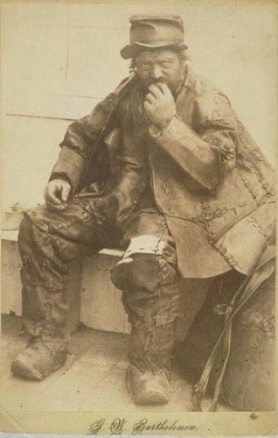
In the late 1800’s the “Leatherman” as he was called, traveled a 400-mile loop on foot mostly through Connecticut and New York State. Clad entirely in deer hide, he spoke a little French and communicated in grunts while journeying between primitive caves, accepting handouts. Legend had it, he shunned the world after being traumatized and while living with my parents, I regularly visited one of his caves with nips of booze.
Generations of kids carved their initials, painted its walls, and built fires beneath the same blackened ceiling crevise the Leatherman used to draw out smoke. Lying on the sandy floor which remained completely dry, even in winter, I wondered if anyone else ever heard faint snoring.
The cave was hidden within a jumble of lichen-covered boulders at the base of a steep ridge deep in a remote hiking area. Typically found on the north side of hills throughout New England, boulder piles were the last to be released from receding glaciers. Other than vegetation, the rocks remained in positions they’d been in since the last ice age sixteen thousand years ago. Refrigerated in summer and insulated in winter, I nodded off in the Leatherman’s cave several times while at my parent’s, listening for ghosts amid the shadowy hieroglyphs, charcoal and cigarette butts, wishing he’d come lumbering in and snuggle up beside me.
 Jed Wolf
Leave a comment