After my heart attack twenty years ago, I refused physical therapy and sat scowling like a stray dog on a hospital bed with a sandbag on my groin. The cardiologist went in through my femoral artery and positioned six rice-sized, lobster trap-looking stents in my coronary arteries which I’d consider the rest of my life. Instead of facing the trauma of nearly dying at age forty-five directly, I glowered at anyone who entered the room.
“Is there anything we can do,” my mother asked, never knowing what to say, ever. My father looked at me proudly as if I’d returned from war and asked how I felt. “Great,” I said, thinking how pathetic earning his respect was. My parents stood uncomfortably for several more minutes looking at me until I told them not to worry and asked them to leave, knowing they weren’t capable of worry, because like me, concern for others was mired in self-preservation.
A nurse bustled in soon after. “Were those your parents,” she asked checking my vitals. “I guess so,” I chuckled, pleased with my cleverness so near death. “You’ll be starting physical therapy tomorrow, after we’re sure you won’t spring a leak,” she chuckled, unable to affect my mood, then examined the colorful bruise in my shaved pubic hair where the angry hole looked like I’d been stabbed with a pencil. “Twice a week for six weeks, depending, but you’re so young,” she pouted, shaking her head, then covered me back up, patted the bed and told me I’d be fine.
Like Hell I will, I thought, shooting her a dagger-look because, not only was my life saved without my permission, I resented being treated like a child. I never returned for physical therapy after that or after my hip replacement a few years later. All I remember from that delirious night dripping with morphine with my thigh doubled in size, was being yelled at by a nurse for standing and screaming at her to, “Get the fuck out!” Rather than return for physical therapy, I said I’d use an exercise bike.
Perhaps from being circumcised at age seven, I’ve never trusted hospitals or anyone who tells me I’ll be fine. After decades involved with my aging parents, once they passed, I vowed to keep as far as possible from the health care system. I joined gyms, improved my diet, tried to release negativity, and live as much in the present as possible to ward off evil spirits. I had nearly two, nearly decent years before Covid when a painful prostate cancer scare and its resultant drug regimens to fix my blocked bladder, seemed to unleash the Kraken.
Within months I woke up permanently blind in one eye from a mini stroke then had another heart attack on the operating table. Having become somewhat inured to high anxiety, and anxious to get my troubles behind me, I decided to get my Dupuytrens contracture surgically removed.
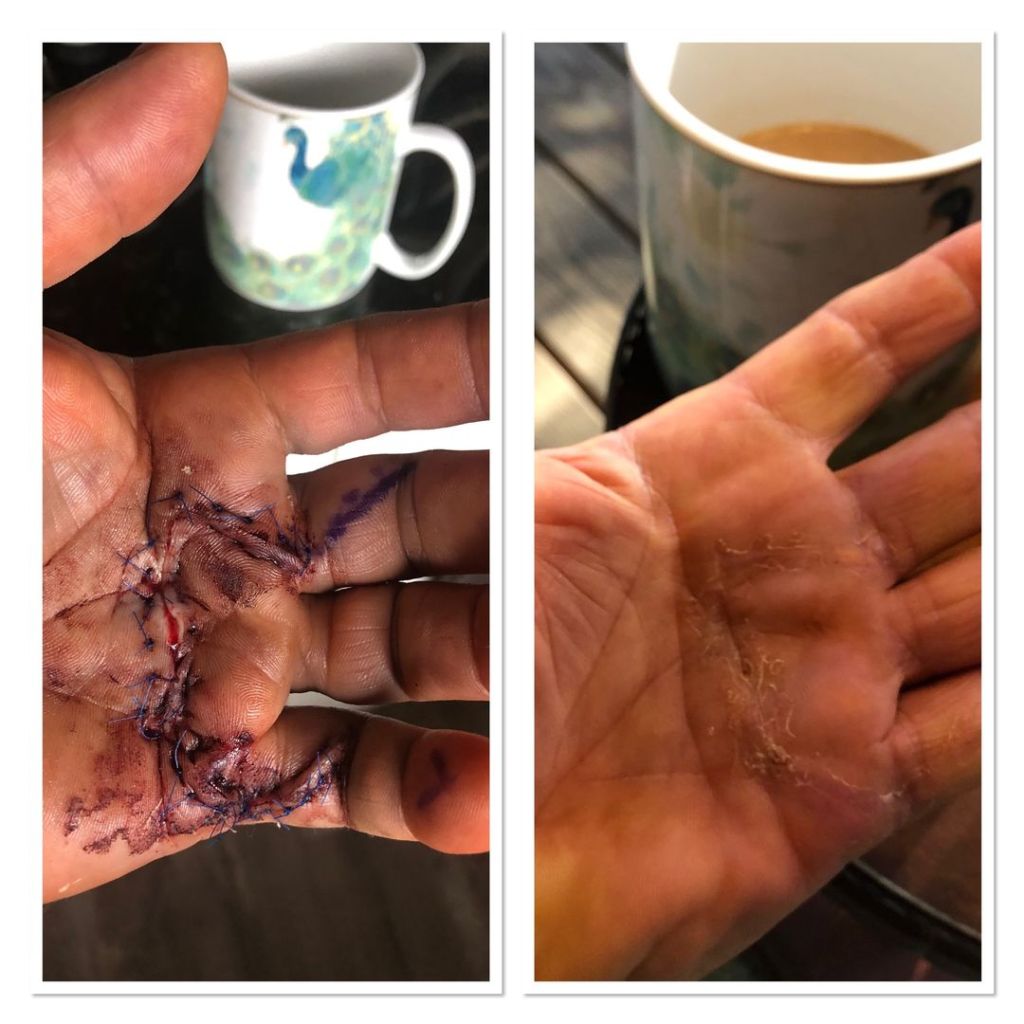
“Vikings disease,” from my Irish heritage, is a progressive tightening beneath the skin which resulted in my crippled claw-like left hand. I returned from surgery with thirty stitches, a bandage the size of a boxing glove, a bottle of Vicodin and an order to return for physical therapy.
Within the bowels of Netflix, are cruel documentaries on the mind-body connection seemingly designed to prey upon the nerves of people recovering from medical procedures. Upbeat gurus say rewiring our brains will not only free us from pain and depression, but unlock our greatness, which for me is like deliberately leaving food just outside my cage and calling me stupid.
When I winced at having each stitch removed, the nurse mentioned a terminal patient who was in so much pain, he decided to end his own life. On the way out, I told her she had lousy bedside manner, recalling had I not cried out and thrashed during my angioplasty, I might’ve died.
I felt like an old fish staring out from a coral reef in my ophthalmologist’s waiting room with my eyes dilated from Bella Donna. I didn’t see the bright side, experiencing what being more blind was like, feeling my way to and from the bathroom several times unable to tell if I had to pee.
“You’re lucky,” my doctor said, beaming his light deep into the abysmally black, left side of my brain. At first, feeling his knee press against my leg, half the age of my own made me flinch, but I didn’t move and enjoyed his physical contact as he leaned in, before he abruptly pulled away and said, “it could be worse.”
For me, looking at the bright side is useless unless it emerges naturally from its opposite. Light dawns when it’s ready, from dark which I believe must be left to become pitch black if necessary for anything of any use to emerge. Like many these days, I have little patience for much besides my husband and cats and can barely tolerate philosophic or cloyingly chipper people. I dreaded my first physical therapy appointment ever and went because my left hand looked and felt like it had been bitten by a leopard seal.
I walked into the fourth-floor suite trying to leave my attitude in the elevator and the first thing I noticed was the view. Looking over the Matanzas River, named for the blood of hundreds of Frenchmen in the 1500s, I felt like an ungrateful traitor for not looking on the bright side.
With green-striped leggings and a bell on the end of her red felt hat, Sarah was dressed like a masked elf. “Nice outfit,” I said, breaking the ice. She shot me the dirty look people I like do before Christmas as we entered what appeared to be “Romper Room.” There were colorful mats everywhere, padded machines, jump ropes and a vinyl-covered king-sized bed. Though the view was staggering, I couldn’t help noticing several bored-looking men in equally embarrassing attire, helping people move to New Age holiday favorites.
I dropped a few other nervous jokes as Sarah sat me down at a half-round table among several others with hand injuries. She introduced me to eight-year-old Luke, who’d cut a tendon in his thumb while slicing an Avocado, his mother who couldn’t stop talking how much blood there was and several other masked men with exposed wounds. When I told Luke at least he wouldn’t have to help her for a while, everyone blinked at me blankly. I blinked back, pointing at my mask wondering what awkward thing I’d say next, as Sarah unwrapped my hand and began to gently massage it.
Physical Therapy reminded me of entering kindergarten with the same uncertainty and ineptness with language. Everyone at the table, on treadmills and stretching on mattresses seemed equally uneasy taking baby steps since fate betrayed them. Some were silent. Others rambled on as a green and red dude who’d heard it all before, finally turned down “The Little Drummer Boy,” hooting on what sounded like beer bottles. “Oh, come on,” a woman squawked, unable to climb her fingers any higher than eye level up a numbered wall.
After allowing Sarah to touch me my hand more tenderly than I’d allowed anyone in my entire life, I wound up alone with her at the table. After pouting when she stopped massaging it, I told her how uncomfortable I’d become around people, especially since Covid. “You’d think at my age, this human interaction stuff would get easier,” I said. “You’d think shedding eighty pounds, and having a job like this, would be satisfying,” she said, without missing a beat.
Though I belong to several on-line Florida Gardening forums, I dare not ask what others think about planting cuttings in the ground in January. I learned from digging graves that most people die right before spring, not from depression, but because unlike any other season, the prospect of facing another new beginning is just too much for them. I expect some cuttings won’t make it and possibly all might succumb to the cold before the March sun heats the ground, but I couldn’t wait.
I told Sarah during my fourth appointment about “Longevity Spinach.” Research shows that along with lowering blood sugar, it lowers cholesterol and has wound healing properties. Another benefit is weight loss so I promised I’d bring Sarah some cuttings to root in her windows overlooking the haunted river to share with whoever might like to grow some when they’re up to it.
 Jed Wolf
Leave a comment