“How much further,” my mother asked, waiting for the light to change in front of the Harlem Valley Psychiatric Hospital. After increasing miles of fields and woodlands, unmarred by human exploits, Barlow was only a half hour beyond the looming brick madhouse, notorious for its groundbreaking lobotomies.
Though my mother disowned her people, and my father regularly broke up his parents’ drunken brawls, no one talked about mental illness in our family. I wondered what percentage of the men wandering beneath the asylum’s incinerator stack were homos, as I gawked at them from the car. Though I had no proof my parents knew, my father gave me a copy of Catcher in the Rye whose narrator Holden Caufield sounded to me like a repressed fag.
By 1970, blue bloods from my Connecticut neighborhood with sons attending prep schools like Choate and Andover were interested in hearing about Barlow, the experimental school they’d read about in the New York Times. “Aldous Huxley, Max Factor and Pete Seeger’s kids go there to name a few,” my father told Mr. Halifax matter-of-factly. “It’s all rather hush hush.” “If giving teenagers free reign among free-spirited teachers with barely a degree among them doesn’t result in drug addiction or psychosis, I’ll eat my hat,” Mr. Halifax stammered.
By the 1955, the “Viewpoint School’s” double entendre, suggestive of Christian brainwashing might’ve reduced admissions, so it was re-named “Barlow” in honor of its beloved founder and Christian Scientist, “Sunny Barlow.” Without spiritual inuendo to affect enrollment, Sunny’s open-minded legacy made Barlow a leader among progressive schools in the 60’s, though the viewpoints I gleaned from my four years on that high hill, made me want to contact Sunny on a Ouija Board.
Located on one of the highest slopes in Duchess County, New York, I didn’t care how pretty it was the day I arrived and didn’t give a shit about Barlow’s philosophy or who I’d be rubbing elbows with. All I knew was how immature and embarrassed I felt compared to the hippies we passed on the way in.
Eight years in boys’ school taught me to maintain composure, but the stone face I’d perfected in those bathroom mirrors wouldn’t be suitable among flower children. Rather than looking tough, or macho, even if I could pull them off, wouldn’t be cool in a place like this, I thought, but acting like a complex artist might. I already could play a few Joni Mitchell songs on the piano, I reminded myself, hiding my bitten fingernails within in my clenched fists.
My grandparents had taken me to see “Hair” on Broadway when I was twelve. I’d anticipated nudity at the end of “Let the Sun Shine In,” for six weeks when, too far from the stage to see anything, I looked away and acted bored during the entire song. I worried these hippies might not be able to keep their clothes on either, as I watched my parents drive away, wondering for the millionth time if my bangs made me look like a girl.
Rather than waving like an orphan, my clench-jawed imitation of a broken-armed Vietnam vet was memorable. I wished my parents would burst into flames or at least shed a tear, as the asphalt gravel popped under their tires like all hope. Had I been more dramatic, my father would’ve slammed his BMW into reverse and embarrassed me, so I squinted like James Dean as my mother didn’t fling open her door and rush back to hug me.
I would’ve felt better knowing they were headed to a bar and would wait forty years to find that out, but by age fourteen, I was exhausted trying to provoke their concern. Used to being dropped off with strangers and relieved to watch my parents drive away through the desolate valley, shrinking from each other’s lives, I turned to evaluate my new surroundings.
Only a few years old, the weathered façade of the “New Dorm,” as it was called, looked already worn out. Part way up the twelve-hundred-foot hill, the depressing grey structure seemed displaced among the hodgepodge of barns, colonial, and other architecture. Taking in its woodpeckered trim and peeling paint, I decided it was too ugly, or the school too dysfunctional for it to be officially named. Like my father, I was right about most things.
It had interested him from a distance, until up close, all he said was, “Wow.” He designed shopping malls and was admired for his taste and talent, but mostly for making others’ judgements seem ill-advised. Rather than criticizing the building’s aroma, oppressive paneling, and stall-like rooms, he’d said, “It’s a dorm for God’s sake,” as if addressing a roomful of nervous investors.
My mother, whose rare opinions had long been squelched by her upbringing and marriage to him, stood unevenly on the well-worn stairs, “This is,” she said, “Fine,” my father barked, whose only true allegiances were to inanimate things. Though my mother said she hated when he finished her sentences, she used getting steamrolled as an excuse to drink. They probably should have split up long before, but I no longer cared. Though I shared his critical eye and her gloom, I was not them, I’d reminded myself listening to them argue my entire life. Though my cynicism was spot on, I didn’t want to condemn my new surroundings without reason just yet or argue with anyone, ever.
Standing on the undulating hill fumbling for a cigarette, I felt expansive, uninhibited and paranoid without a match, ‘til feeling the bulge of my Zippo, I pulled it out, took a whiff of butane and lit a Marlboro. All might seem right with the world until every time I remembered I was a fag. Imagining a girlfriend was equally unsettling so I arched my neck at the unfamiliar vegetation, flaried my nostrils like a range-born colt outside my first barn, galloped uphill about sixty feet and collapsed breathless on my back in a drainage ditch.
Unable to forget my friends under the streetlight screaming “faggot,” I lay with tears streaking past my ears in the cool mowed hay watching the first turkey vultures’ I’d ever seen wheel above. “Timothy,” the tall grass might be, like Timmy in Lassie, I thought, taking a deep breath of it and propping myself up like the crippled girl in Wyeth’s “Christina’s World.” Gazing back and forth between the New Dorm and the beckoning woods trying to recall the words to “The Road Less Travelled,” I wondered what Barlow’s pony-tailed teachers might teach me, if anything.
Another family was unloading boxes in the parking lot as I recalled how “Catcher in the Rye” had confused yet turned me on. I was watching some depressingly cheery parents unload boxes from their trunk when their son flung open the dorm door with a loud crack. Though his rock star looks, and bad attitude were impressive, I hated myself for eyeing him and dropped back into the ditch. Lined with lights and a few wind blocking pines, the main asphalt path in the center of the huge hill was long and steep. Kids stopped to catch their breath several times going up while others ran down beside it recklessly laughing.
Preparing to be stepped on, I pulled a blade of hay to chew, folded my gnawed fingers behind my head, crossed one leg over the other and allowed it to jiggle so I might be avoided and vultures wouldn’t think I was dead.
“Stop that,” my father had whispered during my interview, pointing to my incessant jiggling. Intending to quit all my embarrassing habits at boarding school, I leaped up from my sham reverie and made wading through fifteen feet of blackberries look painless.
Unlike the coastal scrub I grew up near, bird songs reverberated in the nearly vertical, boulder strewn forest. I made sure no one could see me testing dangling grapevines like Snow White then attempting to swing from them like Tarzan. Far steeper than the broad open hillside where kids lay watching the clouds, I leapt up lichen covered boulders, hauled myself onto a ledge and crouched with my arms hugging my tight Levis.
My thrifty mother bought several pair of baggy Wranglers at half the price and my refusal to wear them incited our final clash. I pitied her always losing to my father as Jethro Tull wafted in the distance and vowed to be more considerate of women until noticing a cackling girl in a diaphanous peasant blouse through the trees, treating a shirtless guy like her dog, I decided woman could take care of themselves. Running boys yelled fuck unable to keep their legs under them in the September sun as I leaped off the ledge like a cougar and scrambled further up the treacherous slope.
Reaching the top of the same hill, but far from campus, I caught my breath sweating in the stiff wind as an open field beyond roared with what sounded like applause. Picking one wary leg up at a time, I leaped across a narrow mud road like a wary deer and bounded deep into the cornfield.
I could have fun in here, I thought stopping breathless in the solitude among the husks, then ripped into one with my teeth like a starving animal. The milky kernels weren’t that bad, I thought, when wondering when dinner was, I checked the time on the Bulova my father bought me. Recalling the saleswoman saying I’d grow into it, I flung it off and sprinted down a corn row between slapping leaves overwhelmed by fantasies of the rock star in a New Dorm shower.
Emerging with receding shame from the claustrophobic corn into a newly cut hayfield, I re-committed to jerking off less as it was one of those compulsive habits I’d wanted to break at boarding school. Resisting the urge to roll like a dog in freshly spread manure, I knelt in it instead, rubbed some into my father’s billowy white Brooks Brothers shirt, then leapt up and headed back towards campus.
I appeared unbuttoned from the fields in setting sun, with hair in my eyes and my shirttail flapping, at the house I’d noticed silhouetted at the top of the hill. I might’ve cut across its level yard, until I noticed a group of young women with undulating hair on its porch. With no other choice, I stumbled through an overgrown ditch avoiding their gaze and their lawn like I preferred precarious footing.
“What the Hell happened to you,” one of them yelled as the others giggled with cigarettes dangled from their ringed fingers. Instead of asking them for a light in the stiff breeze, I continued trying not to fall, knowing if I did, I wouldn’t be able to stop. I ignored the view, like I’d seen better, hooked my grubby fingers in my tight pockets and kept going ‘til far enough away to finally stop, I finally did.
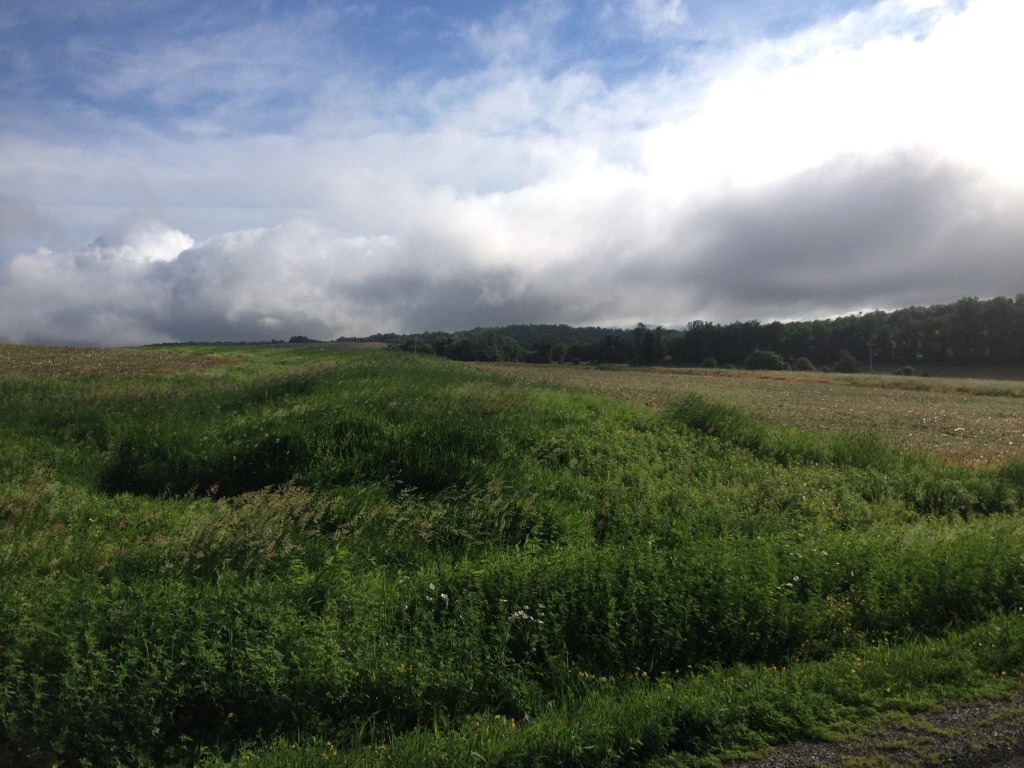
Emptying before me was the widest expanse of landscape I’d ever dared take in. As a little boy, I’d ridden a few terrifying ski lifts, but had been afraid to look at the irregularly shaved, scar-covered bodies of giant sleeping women. I’d felt safer and less exposed within Mother Earth’s recesses until looking out from the top of the Barlow hill, the patterned fields and hedgerows weaving endlessly toward distant mountains peeking in and out of squalls, looked the opposite of frightening.
I felt like an Indian and a falcon watching the slanted sun showers beneath the thunderheads in angled shafts of light and vowed to stop biting my nails for good. Studying the tree shadows embracing each faraway field, I realized I hadn’t chewed them since the car ride up. I’d been too distracted, but now the hill was empty of people. Everyone had gone to dinner.
As free as an animal and relieved as my cuticles to be left alone, with no one knowing anything about me or able to see me acting like a child out in the open, I leapt up and began singing like Julie Andrews, twisting and twirling until breathless in the wind, I fell back deliriously into the timothy like a dizzy, willful nun.
Photo by Stephen Bidwell
 Jed Wolf
Leave a comment