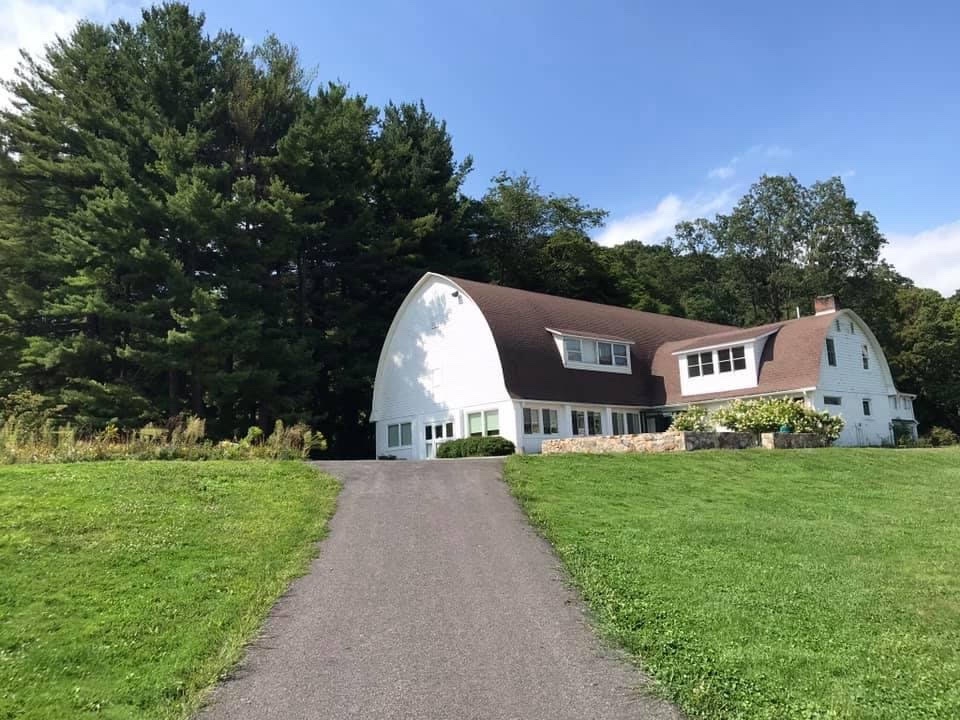
Noticing my tendency to bare my soul with everyone I meet, my husband Dave’s Catholic mother said, I “talk to worms on the street.” Though I’ve never been to confession and I’m as candid with therapists as mail carriers, honesty has nothing to do with Judgement Day.
Barlow had been a dairy farm, possibly a successful one as the main barn was large and the homes, stately. Though it was hard to tell which among the residences and outbuildings were original, not worth researching, to me the verandas, walled gardens and trellises looked subsidized by something other than cows. With the air of a summer retreat from a bygone era, without being so sorely needed by addled adolescents, the school’s clapboard origins, beneath layers of sagging paint, would’ve rotted into the hill in a season.
Remnants of horizontal cow paths crisscrossed the steepest part of the hill beneath a defunct rope tow. Few athletic traditions remained by 1970 when maintenance couldn’t manage much more than mowing and paint. Skiing was abandoned along with basketball, horseback riding, and tennis to make way for stoned adolescents to roam like Holsteins.
A horse or two lingered when I arrived, in barns at the bottom of the hill along with an obsolete Castilian riding teacher who vanished soon after. There was an abandoned tennis court, a rotten wooden dingy beside a large algae-choaked pond and an overgrown orchard where peppermint grew in horseshoe pitching boxes amid ghosts.
The “Schoolhouse” was the hub of campus. Originally the gabled cow barn, the former hay mow had been converted into an auditorium. Underneath where milking stanchions had been, was a hallway with classrooms on either side leading to administrative offices. Up a wide set of stairs, an arched plywood ceiling suspended with caged lamps vaulted over hardwood basketball courts memorialized under thick shellack. Mesh windows too high to see from, with heavy light-blocking drapes buzzed with dusty insects while tortured student paintings haunted the unfinished, tanned walls.
I approached the backside of the schoolhouse from the woods and seeing an open door at the top of a fire escape, I climbed the metal steps past cans of cigarette butts and peered into the enormous room for the second time.
The winter before after my interview, there’d been a rehearsal and I only peered in. The stage-lit actors looked vibrant and professional but the teacher’s, intimidating screams reminded me why I hated performing. Prepared to get yelled at for being there unauthorized, I crept further in.
Except for gentle buzzing and the ceiling’s occasional church-like creaks, the room was silent as the highest screen-covered windows dropped rectangles of blinding light onto the shaded floor. Weighted velvet curtains hung above a stage at one end and on the opposite wall, layers of cathedral-like pipes shot up within a structure of beams – a church organ reconstructed by ambitious students before marihuana I presumed.
Rolling racks of metal chairs filled one corner and in the other, parked below the stage, an ebony grand piano waited modestly. With its curved legs perched on eight-inch wheels, the Steinway looked like a dancer in mid-flight, unable to land until played. Every self-conscious step I took toward it reverberated. The keyboard lock sitting on the bench enticed me to open the lid which creaked loudly despite the worn felt. Gently pressing one note, I could tell the whole thing was in perfect tune.
My father bought a Steinway. Though he said it was for me, I could never tell. Besides looking great in his high-ceilinged living room, the pressure on me to play it brilliantly ‘caused it to gather dust more than it should’ve.
I’d been uncomfortable hearing my painfully chewed fingers vibrate big rooms, but the Barlow auditorium felt like a basilica. I never liked playing for strangers especially on command, but no one was around when I sat down at that Steinway for the first time. I took a deep breath and began to play Joni Mitchell’s “Circle Game” which had impressed girls at home but bored my father who preferred Bartok. Tenderly and dampened, I began her introduction without overwhelming the room’s ambient buzzing and creaks as if playing the soundtrack for a movie I was in. My heart began to break as usual over the years I’d wasted without lessons, unwilling to practice, while complicated emotions informed every note, but the resonant room was too forgiving for self-pity. Sonorous chords poured out effortlessly, inspiring a touch and sensitivity I’d never experienced. Pain vanished as I delicately recalled mundane Carol King and James Taylor progressions I’d dutifully played for friends, then broke away into complex improvisations with the dexterity of someone else. Perhaps I should be a Julliard, I thought wishing my father could hear, as my confident hands chased each other across the keys.
He was an amateur musician with refined taste who said I’d never amount to anything without lessons. Though I could never prove him wrong, I improvised well enough to torture him. Knowing he was listening from another room; I taunted him with doleful melodies just to hear him scream. When he burst in declaring he’d send me to Julliard, I stopped, said nothing, and only continued playing once he left.
If I hung moments too long on sweet phrases, he’d yell, “change” from the other room, but I never changed when he demanded. I’d make him think I was a sap, then wham, jar him with all the previous motifs in a fugal cacophony beyond his wildest dreams.
When I was twelve, he got me a job playing piano at “The Admiral Benbow,” a chichi floating restaurant on the Greenwich, Connecticut waterfront. He told the owner I was a prodigy. After sitting terrified unable to play, we said nothing on the ride home. I didn’t want to be a prodigy. All I wanted to do was make him pay.
I’d given up caring about the piano until playing that day in the auditorium, I heard someone singing, “Fearful when the sky was full of thunder and tearful at the falling of a star…” I joined in seamlessly after her first resonant line as she walked slowly toward me singing like a professional. By the time she reached me, she was in tears. “Where did you come from,” she asked incredulously. “Where did you come from?” I answered, thinking I might just survive boarding school.
Though she was about seventeen, she looked to me about thirty-five. A lot of girls at Barlow looked wise and damaged beyond their years and the technically perfect pain pouring from her lungs was heartbreaking.
“Excuse me. That piano is supposed to be locked,” a voice said startling us both. “Oh come on Harvey,” she said. “Get outa’ here.” The unfortunate looking man with the beady eyes I’d noticed at orientation, cleared his throat and fumbled with a key ring ‘til he held the one for the piano lock. “Everyone will want to play it if I let him,” he whined, pointing at me.
“Jesus Christ Harvey. Leave us the fuck alone,” she barked as if talking to a subordinate. His red face got redder and shiny, as he inhaled and sucked his teeth. “I’ll give you five more minutes,” he said, shaking his finger. “Screw you,” she laughed. “We’ll need an hour.”
Photo by Betty Canick
 Jed Wolf
Leave a comment