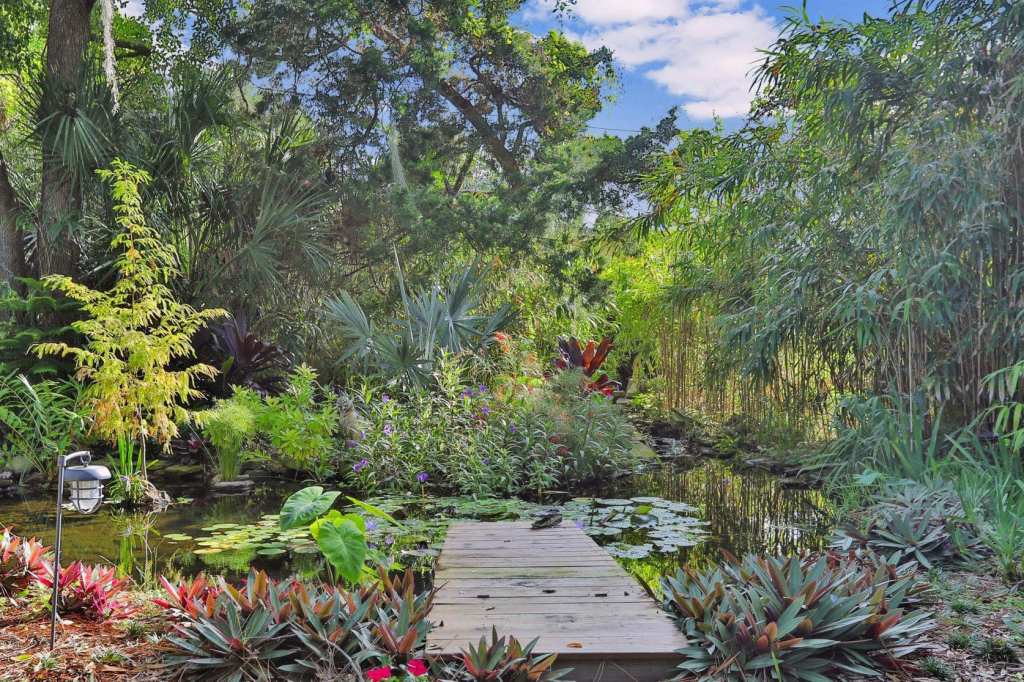
“I’m gonna’ make it harder for you to die,” I said, grabbing garden tools from the bed of my truck and heading toward Eileen’s precious backyard which had been devastated by cold and floods. At eighty-five, Eileen knows I’m easily bored and like to keep everyone on their toes. “You might have enjoyed my father or thought he was a complete asshole,” I said, sounding just like him..
“Did either of your parent’s write?,” Eileen asked, holding the gate open. “My mother liked Virginia Woolf and kept a bedside journal of dreams and diatribes about coping with my father. He was into philosophy, Jung, Alan Watts and Meister Eckhart but he never dared write, paint or play music. He was an architect and liked control,” I said, dropping my tools. “And you’re a landscape architect,” Eileen said, picking them up. “Never professionally.” “Why not?” “Because he’d have liked that,” I said turning on a hose, “and I wasn’t about to please him, not his way anyway. “He liked straight lines, I liked curves.”
Eileen ran a successful textile company for many years where she met several gay men who became lifelong friends. “You would’ve made good partners,” she said. “Nah, we were both dicks which also happened to be his name.” “Ah, what’s in a name,” she said, sweeping mulch off a new winding path. “The bane of my existence, that’s what,” I said, glancing toward the sky while watering in liriope. “Richard is my first name and you know what that stands for.” “I’ve known a few Dicks in my day but none so talented and handsome,” she said, batting what was left of eye lashes. “I don’t mind being a lot like him, except for the wounded parts. We were like twin children.” “Separated at birth,” “Yeah, my birth,” I said, ready to change the subject. “Like most fathers and sons,” Eileen added.
“He cracked my ribs hugging me once,” I said, boyishly pointing at the protruding bump on my ribcage. “Did you know the name Dick means ‘hard and strong’ in early German?,” I asked Eileen, who at her age appreciated all the entertainment she could get. “He was always showing off h he was deeply insecure which he never talked about, which is why he never wrote and why I do. Before naming me Richard, he’d originally named me Wolfgang which means ‘path of the wolf’ but chickened out.” “So, what is your given name?” Eileen asked. “Richard Jed Katzman,” I said trying not to sneer. “I’d have preferred ‘Wolfy’”
“And you’re an accomplished musician. Can you imagine,” Eileen said, looking like she was about to refer to God’s mysterious ways. “The indecisiveness?” “No, I mean how somehow he intuited the path you’d take.” “Interesting,” I said, appreciating her attention. “Or did his fear create my path not to mention their alcoholism which is why I named myself ‘Jed Wolf’ as in, raised by wolves,” I said, admiring her luxuriant, low-maintenance dry creek bed and the new railing we were leaning on. “My stage name,” I added, shamefully, having never liked it either. “Do you spell Wolf with an e,” she asked pointing to where she’d like a sign mounted on the railing. “No plaque,” I said. “Please. You can’t be serious. I don’t want credit.” “But it looks so beautiful. I want to do something to honor your creativity.” “Just don’t die,” I said, coming full circle. After a few more moments appreciating her backyard universe in silence while leaning on the new railing, she said, “hey,” pointing to herself. “I lean here. Get it? Glad to know you Wolfy.”
The timing was perfect. I’d committed to compiling a memoir for the umpteenth time and would much prefer throwing myself at a gardening project like hers or off a bridge in order to avoid writing. While driving to pick up hardy plants, I ask her what she thinks God was resisting while creating the earth. “What dug in its heals on the seventh day and dragged him backward,” I asked Eileen, who’s a catholic. “Now there’s a memoir,” she said, without skipping a beat.
My first memory of doing yard work at around age five wasn’t with my mother whose tomato plants shrank after planting. My best friend April’s nanny squawked if I even glanced at her begonias, but I wasn’t like April’s older brothers. I wouldn’t hurt plants. I found their sap as disturbing as blood who’s stains equally enraged my mother and I felt sorry for mowed lawns.
Forty miles east of New York City along southern Connecticut’s flood prone coast, April’s mother Jane who had one blue and one green eye swam on summer mornings in the 1960’s naked in their pool. An unctuous professional actress with fake grapefruit-like boobs, a boudoir, boozy husband and three gorgeous kids, Jane Wenman, who didn’t mind being mistaken for Jane Wyman read Christian Science literature to us kids by their pool, sometimes wearing only a towel. Unlike my mother who grew up poor, refused to replace dead bushes and gritted her teeth, Jane inherited millions acted relaxed and replanted her yard after every storm as if her grip depended on it. They had a live in Nanny because Jane was an in-demand actress. As a Christian Scientist, she didn’t believe in medicine so forsythia, floral fabrics, facelifts and an occasional Gin Fizz helped her endure motherhood.
All the women pretending to raise children on that close knit peninsula had problem kids. Sons were plied with boats and daughters, horses, except in our house where things were reversed and after getting a taste of our incestuous neighborhood, younger couples rarely stayed despite the parties.
I knew all the hiding places in everyone’s yard, and I left peeled pages from rain-soaked Playboys in newcomer’s forsythia to scare them into leaving sooner. I could handle losing some of my overgrown dens to new landscaping except for one – a neglected corner of April’s side yard dedicated to trolls. The neighborhood we constructed for our dozens of sexless belly buttoned dwarfs with innocent eyes and long colored hair kept growing. Herds of April’s elegant lifelike horses posed in blooming orchards. Over one summer, our expanding village connected by winding pebble-paved roads and bridges could be seen from the corner of her parent’s cocktail patio, yet we were allowed to use the hose to continue making trickling waterfalls, without being yelled at, “why?,” I asked. “Because God is love,” April said, as if on cue.
“In’t this cunning,” Jane twittered, in the cartoon voice she always used around children. When we pleaded “Please leave it,” with praying hands beneath the old maple, she cocked her head, said “awe,” left to find a camera and never returned. “She won’t be back,” April growled, but I didn’t care. I was too young to know why April scowled whenever her mother lavished me with attention for raking their leaves or why their family suddenly moved across the country. I’d have done anything for either of them but would have thrown myself into fire for April who grew up way too soon.
“What gay boy doesn’t have an affinity for tragic women,” I heard much later from a fellow writer who read my stories with a yawn. After watching my autobiographical one-man-opera, a director said,” you know it’s really unattractive for someone your age to have so many problems.” Yet like April’s mother who acted exactly as she always had before she died and my mother who near death repeated, “I was never the same after Jane left,” as if in a horror movie, I thought I might be an actor too.
“Of course, you are,” my mentor said, forty years later when I told her I felt crazy. “Let’s see it,” she continued, motioning for me to get up with a gentleness I dared not trust. “All my most brilliant students have tragic backgrounds.” Fixing her hair, she began explaining how acting saved her life. I listened intently, learning about how techniques she’d be teaching me had transformed her from an insecure midwestern coed into an Obie award-winning actress who starred alongside Merrill Streep, Cher, and Dennis Quaid. “Mike Nichols saved my life,” she said, “by believing in me,” she added with a convincing drop in her voice and was hooked. From then on, E. Katherine Kerr would be saving mine in exchange for yard work.
 Jed Wolf
Leave a comment