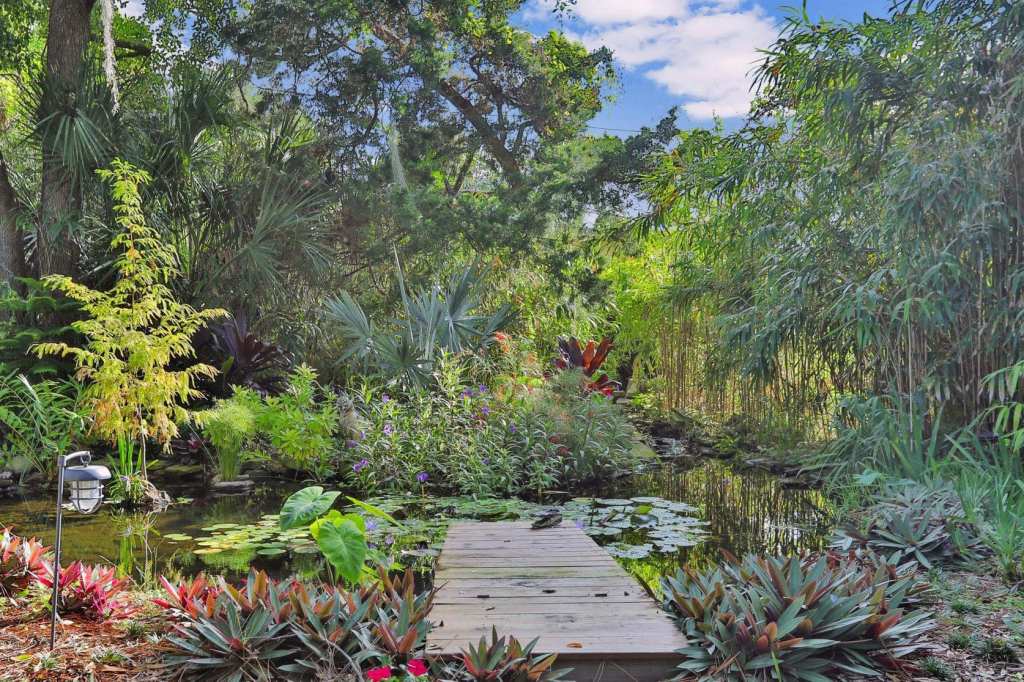
“I’m gonna make it harder for you to die,” I said, grabbing garden tools from my truck bed and heading toward Eileen’s precious backyard, devastated by cold and floods. At eighty-eight, she reads minds as I do at sixty nine, probably sensing my boyish need to fix things for women who might vanish like my mother, or April and her mother Jane, or all the others who’d slipped away while I was still processing their effect.
“Did either of your parents write?” Eileen asked, witchlike, holding the gate open like she was letting me into more than just her garden.
“My mother loved Virginia Woolf and kept a bedside journal of dreams and diatribes about coping with my father.” I dropped my tools with practiced carelessness. “He was into philosophy, Jung, Alan Watts, and Meister Eckhart, but never dared write, paint, or play music. He was an architect and liked control.” I said, in a vain attempt to explain why I’d grown up preferring women’s company.
My first memory of doing yard work wasn’t with my mother, whose tomato plants shrank after she planted them, as if mimicking her retreat from life. No, it was in April’s yard, where her mother Jane—who had one blue and one green eye—swam naked in their pool on summer mornings in the 60s. Jane Wenman, with her grapefruit-like boobs and boudoir manner, read Christian Science literature to us by the pool, sometimes wearing only a towel. Unlike my mother who grew up poor and gritted her teeth at nature’s affronts, Jane inherited millions and tended to the debris in her yard after every storm as if everything depended on it and I worked in her garden like a pilgrim seeking benediction.
I knew all the hiding places throughout our overgrown neighborhood, leaving peeled pages from rain-soaked Playboys in newcomers’ forsythia to scare them away. But my sacred space was the neglected corner of April’s side yard dedicated to trolls. Our secret village of sexless, belly-buttoned dwarfs with long hair and innocent eyes grew tended to corals of April’s elegant lifelike horses, all posed in blooming orchards of crabapple sprays and rose blossoms from her mother’s yard. Visible from her parents’ cocktail patio, Jane never commented on it, but her silence felt like permission to beautify as aggressively she did.
“What gay boy doesn’t have an affinity for tragic women,” a fellow writer once yawned while reading my stories. After watching my autobiographical one-man opera, a director said, “You know it’s really unattractive for someone your age to have so many problems.” But like Jane, who acted exactly as she always had before she died I assume among billowing vases, and my mother who near death repeated, “I was never the same after Jane left. I was never the same,” as if in a Fellini movie, I thought I might be an actor too. We were all performers weren’t we?
“Of course you are,” my acting teacher E. Katherine Kerr said forty years later when I told her I was crazy. “Let’s see it,” she continued, motioning for me to read scripts with gentle encouragement I dared not trust. “All my most brilliant students have tragic backgrounds,” she said, as if offering me a role I’d been rehearsing since childhood. Simply put, she’d be saving my life in exchange for a little yard work. Like Norma Desmond in Sunset Boulevard, she’d teach me to transform like she had—from an insecure Midwestern coed into an Obie award-winning actress who starred alongside Meryl Streep, Cher, and Dennis Quaid, while she fell in love with me.
Back in Eileen’s garden, after a few moments appreciating her backyard universe in silence while leaning on the new railing, she said, “Hey,” pointing to herself. “I lean, Get it? Glad you’re here” And for some reason, I didn’t feel the need to deflect her honesty with a clever response.
 Jed Wolf
Leave a comment